Boundary Illusions
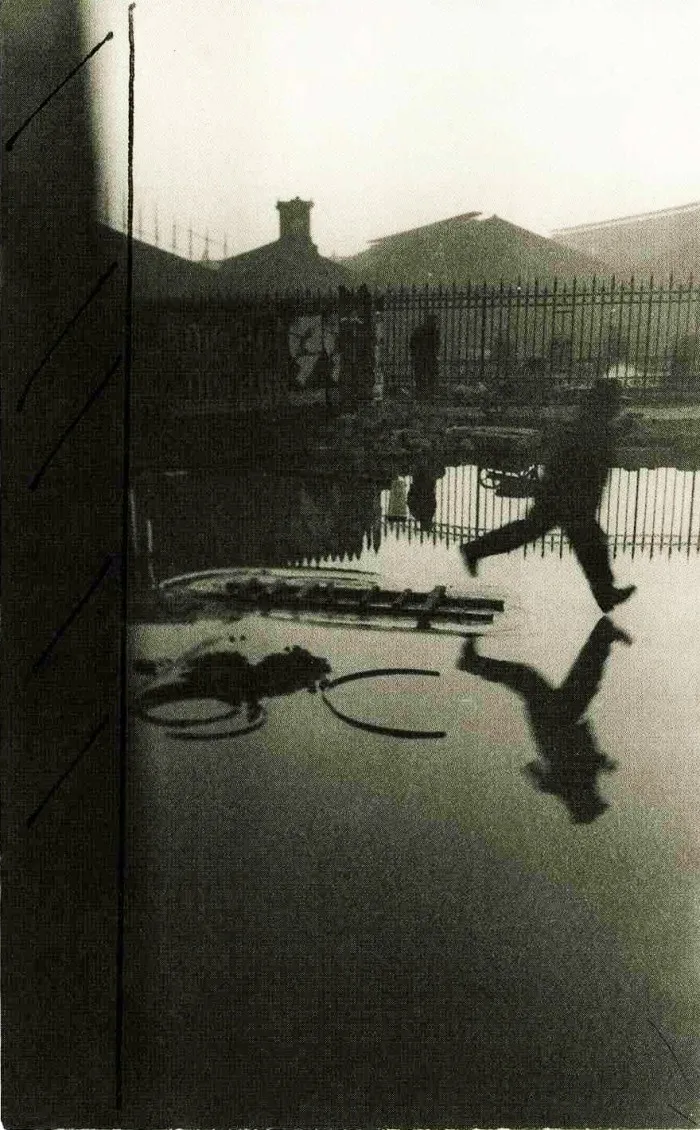
The photographer Henri Cartier-Bresson was famous for arguing that composition must take place in the viewfinder, rather than the darkroom. “If you start cutting or cropping a good photograph, it means death to the geometrically correct interplay of proportions,” he claims.
This was a courageous take, especially at the time, when 35mm was rare and expensive. But it hinted at a universal truth: the photograph doesn’t exist within the boundaries of the frame, but includes the frame itself. The frame operates and organizes the entities within, not functioning as a cliff but as a guide.
The phenomena of boundary selection isn’t relegated to art. One of the core responsibilities of an engineer is not to think in global laws but apply boundaries to a system. We are confined to certain physical realities – Newton’s laws, $E=mc^2$, thermodynamics, conservation – but we’re not trying to describe the world, we’re trying to make a decision on a system. A reactor failing makes physical sense because entropy is created, heat is lost, material is converted to energy predictably. But it does not make sense to us, the designers, who are responsible for engineering a system that operates productively by our definition but also within the boundaries of physics.
The goal, then, is not to manipulate physical reality, but to create a manageable one. The goal is to frame.
How Do We Manage?
The challenge is the frame selection: what do we include to selectively manage and manipulate. This can look like a lot of different things: which products we select for market, which market segments we format for, what design choices we make.
In commercial terms, we optimize for technical resources, timelines, capital efficiency, and measurable outcomes. In engineering terms, we optimize for stability, throughput, and control. In policy terms, we optimize for legibility: what can be counted, governed, and reported.
In each case, optimization requires omission. We select objectives and formalize them, and everything else becomes externalities. What we include consumes capital, attention, and legitimacy. What we exclude becomes opportunity cost: not erased, but displaced beyond the system’s accounting.
But optimization is never free. Every boundary excludes variables that still act and still accumulate pressure.

This is the quiet illusion of framing: that exclusion is equivalent to irrelevance. In reality, it is merely displacement. Risk, uncertainty, opportunity, labor, and failure are not eliminated by being excluded from the system. They are reassigned to another team, another market, another community, or another moment in time.
What do frames look like?
In chemical engineering, system boundaries are drawn to make equations solvable. Heat loss becomes a term. Side reactions are ignored. The model converges. In production, those ignored reactions foul catalysts, warp vessels, and shorten lifetimes. The physics was never wrong, the frame was incomplete.
In biological research, we select model organisms and controlled environments because they are tractable. The intervention works in vitro. The signal is clear in mice. What remains excluded are environmental variability, long-term adaptation, and human context. Translation becomes the rediscovery of what the frame left out.
In organizations, we define success through metrics that can be counted: quarterly growth, customer acquisition, cost per unit. Culture, long-term resilience, and latent risk remain harder to quantify. The system optimizes for what is legible. Over time, the measurable becomes the mission.

Framing determines not only what a system can solve, but what it is allowed to know. Early choices harden into reporting structures, metrics, and incentives. Metrics become dashboards. Dashboards become strategy. Strategy becomes goals. Over time, a provisional frame calcifies into institutional knowledge, and what began as a modeling convenience becomes “how the system works.”
The system becomes increasingly efficient at solving the problem it defined and increasingly blind to the problems it excluded. Systems rarely fail because reality violates the model. They fail because the model trained the organization to ignore what did not fit.
Boundary selection is therefore not a technical prelude to “real work.” It is the work. How we formulate a system determines not just how we solve it, but who benefits, who absorbs the cost, and who remains invisible. The illusion is that the frame is neutral. The reality is that it is decisive.
Cartier-Bresson insisted that composition must happen in the viewfinder because once the frame is set, the photograph is already determined. The same is true of systems. By the time we are debating outcomes, budgets, or reforms, the geometry has already been chosen. The proportions were fixed when we drew the boundary, and finalized when we defended it.
Enjoy Reading This Article?
Here are some more articles you might like to read next: